
Fujian
Fujian Province known as "Min", popular as ancestral homeland of many overseas Chinese. Located in the southeast region of China, Fujian province facing Taiwan across the Taiwan Strait. It spans an area of 121,400 square kilometres with a population of about 35,110,000. Neighboring provinces are Zhejiang to the north, Jiangxi to the west, Guangdong to the south, and East China Sea to the east. Hok-kian, Hokkien, Fukien, and Fuchien are all refer to Fujian province.
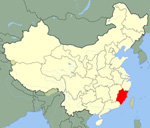 "Fujian" comes from the combination of Fuzhou and Jian'ou, Fuzhou is the capital of Fujian, while Jian'ou is a name of county level city in Nanping area. It was named during the Tang Dynasty. As one of nearest gate that connected China to other regions, such as Southeast Asia, West Asia, Mediterranean, and East Africa led Fujian as trade center and cultural exchange in the China's history. At the age of ancient "maritime silk road", merchant ships sets sail from Guangdong and Fujian province carrying Chinese silk, porcelain and tea via Malacca Strait to India and Persia (today Iran).
Fujian coastal territories faces South China Sea to the south, East China Sea in the east, and the Taiwan Strait in the southeast. The River Min flows the land in northern and central Fujian.
Fujian province is mainly mountainous, with northwest area has higher altitude. Wuyi Mountains which is located in Nanping region forming border between Fujian and Jiangxi Province. Huanggang Peak (2157m) in the Wuyi Mountains is the highest point in Fujian.
The Han Chinese is the most population in Fujian province. There are various Fujianese peoples (Min-speaking groups) as the largest subgroups in Fujian. The Fujianese peoples includes Foochow people, Teochew people, Hoklo people, and Putian people.
Another subgroup of Han Chinese is Hakka people, who live in the southwestern part of Fujian. Hui'an people which has distinct culture and fashion also subgroup of the Han, they are mostly populate in Hui'an County, in the southeast coast of Fujian. The She people dwelling around mountainous area in the northern Fujian.
Fujian province blessed with fertile lands, evergreen mountains and rich resources sea. Rice, potatoes, wheat, lychees, tea, and seafood are the main commodities in Fujian. Fujian province well known as production center of tea in China. According to the written record, the production of tea in Fujian began since 4th century. Base on long experience about tea producing, makes Fujian province constantly produces five kinds of tea, such as Oolong tea, black, green, white and scented tea. Wuyishan tea is one of the most famous tea in the world. More about Fujian Economy
Fujian climate is subtropical, with warm winters. In Januari the coastal areas has temperature about 7-10�C, while the hills and mountainous area around 6-8�C. In the summer temperature are quite hot.
- Changle International Airport in Fuzhou
- Gaoqi International Airport in Xiamen
- Jinjiang Airport in Quanzhou
- Wuyishan Airport in Nanping
There some type of universities in Fujian, with following notation is used:
* National: administered directly by the Chinese Ministry of Education (MOE)
* Provincial: Public university administered by the province
* Municipal: Public university administered by the municipality
* Private: Privately owned and funded university
National
* Huaqiao University (Quanzhou)
* Xiamen University (founded 1921)
Provincial
* Jimei University (Xiamen)
* Xiamen University of Technology (Xiamen)
* Longyan University (Longyan)
* Putian University (Putian)
* Quanzhou Normal College (Quanzhou)
* Wuyi University (Nanping)
* Zhangzhou Normal College (Zhangzhou)
Fuzhou
* Fujian Agriculture and Forestry University
* Fujian University of Traditional Chinese Medicine
* Minjiang University
* Fujian Medical University
* Fujian Normal University (founded 1907)
* Fujian University of Technology
* Fuzhou University
Private
* Yang-en University (Quanzhou)
See also : List of Universities and Colleges in Fujian
Fujian has the most diversification of language in China, this is the effect of the wave of migration from central Cina in ancient history. Thus Fujian has many local dialects, that classified as Min category. Min dialect consist of seven subgroups which are Min Dong, Min Bei, Min Zhong, Min Nan, Shao Jiang, and Pu Xian. The seventh subgroup is Qiong Wen which is not spoken in Fujian. Fuzhou dialect is influenced by Min Dong and Min Bei, and Min Nan is used in the area of Xiamen (Amoy).
Fujian people surely speak Mandarin as official language, which is used for formal situation and for communication with people from other regions. In daily situation, most of them used its own dialect for communication amongst local people. More about Fujian Culture
Fujian Cuisine, especially seafood, is one of the eight Chinese Cuisine great traditions. Fujian cuisine is influenced by various traditional recipes, including Min Nan Cuisine and Fuzhou Cuisine. The most famous dish in Fujian is "Buddha jumps over the wall" (Fotiaoqiang), is an amazing dish from combination of many ingredients, including abalone, sea cucumber, shark fin, and shaoxing wine (a kind of Chinese beverage)
Fujian is well known as one of the best tea producer since ancient time. The word "tea" in english is derived from Min Nan language "cha". Tea ceremony has become the traditional culture in Fujian, it is the way of preparing and serving tea. The Wuyi tea, oolong and Fuzhou jasmine tea are some of popular tea in Fujian.
Tourist Destinations in Fujian Province
- Guanghua Temple in Putian
- Gulangyu Island in Xiamen, known as "Garden on the Sea"
- Hakka Round Houses in Longyan
- Kaiyuan Monastery in Quanzhou
- Meizhou Island in Putian
- South Putuo Temple in Xiamen
- Wuyi Mountain is a famous for its scenery area and tea garden
- Yongquan Temple in Fuzhou
List of Fujian Cities and Counties