
Nanping
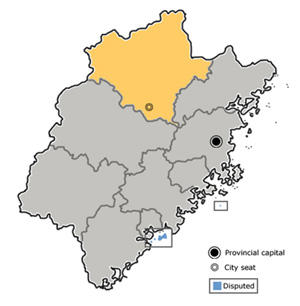
Nanping is a prefecture level city and has the biggest area in Fujian Province. Located on upper of Min River; northwest of Fujian Province, Nanping occupied an area of 26,000 kilometers, which is half of them covered by forest. Nanping can be reach via Wuyishan Airport, southern outskirt of Wuyishan City, both 7 kilometers (4.3 miles) from the downtown Wuyishan and Mount Wuyi Scenic Area.
Nanping is one of the important birthplaces of Fujian's culture and great peoples that carved the history. As early as 1,800 years ago during the Eastern Han Dynasty, administrative system was established here. Even its younger counties, such as Shaowu, Jianyang, and Wuyishan, have been existed for about a thousand years. History records about 17 feudal Prime Ministers and 2,000 Jinshi (a successful candidate in the highest imperial examinations in ancient China) were Nanping born.
Surrounding with mountain, Nanping is identical with tourism area which led by Wuyi Mountain, the most famous scenic area in Fujian Province. Another interest destination are Mangdang Mountain, Fugai Mountain, and Guizong Hill. Currently, a tourist network consisting of more than 150 scenic spots have been formed.
Map of Nanping
Nanping is highlighted on this map
�
Nanping Tourist Destination
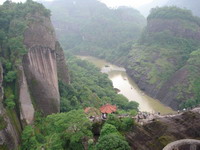
Wuyi Mountain Scenic Area is situated in southern suburb of Wuyishan City, streched along the border of Fujian and Jiangxi Province. It covers an area of 70 square kilometers, with 36 exotic shape peaks, 99 bizarre crags and the crystal clear "Nine Twist Stream" (Jiuquxi) that form a marvelous natural landscape. In November 1982, Wuyi Mountain was designated as one of the first batch of State Scenic Area, and on 1999, it was listed in UNESCO's World Natural and Cultural Heritage Site.
Minyue Ancient City is a key national cultural protection, which is located only 1 kilometer away from Chengcun Village, in the area of Wuyishan City. Minyue Ancient City is another important evidence of Wuyishan extraordinary past. This city is a witness for the Minyue Kingdom's history, culture, economy and politics, as well as a masterpiece of architecture.
Mangdang Mountain is situated about 15 kilometers away from the downtown area with its highest peak rising 1,363 meters above sea level. The land area is about 120 square kilometers including major beauty sights as the the Stone Buddha Hill, Headstream Valley, the 3,800 Ridges and the Cloudily Longing Ocean. The mountain is famous for its deep valleys and remote forests, clear streams and imposing fog.
Known as “little Huangshan Mountain”, Fugai Mountain covers an area of 10 square kilometers. From a distance, it looks like a dragon lying across Fujian, Zhejiang, and Jianxi provinces. Xu Xiake (1587-1641), famous geographer and traveler of the Ming Dynasty, visited the mountain three times, travelling through all the scenic spots and views, such as the Gauze-hat Stone, Lotus Cave, Bat Cave, and Chessboard Stone. He even left a record of his impressions in an article titled Records of Visiting Fugai Mountain, in which he described the mountain as a place of great attraction.
Heping Town is located in North-West of Fujian Province and has a minimum area of 192 square kilometers. It was originally built in the Tang Dynasty and is one of the oldest cities with a great history in the province of Fujian. It is a unique castle in the style of the old town, and one of the ancient preserved town in Nanping.
Guizong Hill in Jian'ou
Known as the Lesser Wuyi Mountain, Guizong Hill is at the mouth of the Yijun Stream, 15 kilometers north of Jian'ou City. It is a low-lying hill, with its highest peak rising 596 meters above sea level. There are ten scenes, three caves, and one temple. These include Tingquan Pavilion, Xianglu Peak, Luozhu Cliff, Shixin Spring, Lingxu Terrace, and the Chongren Buddhist Monastery.