
Anxi County
Anxi is located in southeast area of Chinese Fujian Province, underi the municipal region of Quanzhou Prefecture. It lies adjacent to and directly north of Xiamen. Anxi is well-known for its sort of Oolong tea, Tieguanyin (铁观音, "Iron Boddhisatva of Mercy").
Anxi County presently governs 458 villages (occupies, field), administrative village 433, area 3057.28 square kilometer, population 1,060,000. Anxi is the subtropics area, the mountains and rivers is beautiful, the soil is fertile, the rainfall is abundant, the annual mean temperature 18-21 C, frost-free period reaches above 310 day, the annual mean sunshine amounts to 1850-2050 hour.
Tourist Destination in Anxi County
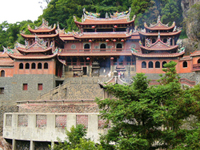
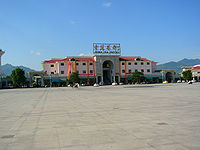
Qingshui Rock (Qingshui Yan)
�
�
Chinese Tradition of Drinking Tea
According to Chinese tradition, the original cup of tea was not invented but discovered in the course of daily affairs by the simple inhabitants in the hills of Min-nan, who found out the secret of preserving the essence of the green tea leaves. It was rolled and dried and good for keeping until when needed.
In modern China, virtually every dwelling--down to the simplest mud huts--has a set of tea implements for brewing a hot cup of tea. These implements are symbols of welcome for visitors or neighbors.
Traditionally, a visitor to a Chinese home will be expected to sit down and drink tea while talking; the Chinese consider having such visits while standing to be uncouth
I call it the root cause of our 5000 years old culture. Actually it's only a drink, ie. I drink hot tea, cup after cups of it without any problem.
"Far deeper than the formal trends of common values in Chinese culture is found with simple plant known as tea. It is an essence discovered by the simple farmers while trying to enhance their tasteless water. Tea is found all over scattered in the many parts of China. Without tea, there will not be any real roots to the real cause of the Chinese culture."
District Name |
Licheng District - Fengze District - Luojiang District - Quangang District |
City and County Name |
Anxi County - Dehua County - Hui'an County - Jinjiang City - Kinmen County - Nan'an City - Shishi City - Yongchun County |