
Fuzhou History
Fuzhou History in Ancient Time
According some archaeologist, the area which the modern Fuzhou sits, has been occupied by ancient tribe since 5000-7000 years ago. Around 2100 BC, when the Xia Dynasty reigned, the ancient tribe of Fujian began to contact with northern Kingdom, and later they have closer relation.
The Fuzhou history also closely related to Minyue Kingdom, when a branch of Yue royal family moved to southern region when the Yue Kingdom (in present-day Zhejiang province, north of Fujian) fell to Chu Kingdom in 306 BC. Yue royal family later established the Minyue Kingdom, with their city centre located around Wuyishan City. However, the exact foundation of Fuzhou is not known clearly.
The first city wall of Fuzhou was built in 202 BC when Liu Bang, the founding emperor of the Han Dynasty, gave permission to Wuzhu, the king of Minyue, to set up his capital in Fuzhou. The city was named Ye, meaning "the beautiful". The city name has changed many times, and Fuzhou has been occupied continuously since its first wall was built. The Minyue Kingdom was annexed by Han in 110 BC.
Han Dynasty to Song Dynasty
During the Han Dynasty, Fuzhou known as Ye County.
During the Jin Dynasty, West Lake and East Lake and numerous canals in the city were constructed (282 AD). When the Jin Dynasty collapsed, the first wave of immigrants in Fujian (308 AD). In 964 AD, Hualin Temple was established in the original Ye city, later the site has been declared a national heritage site.
During the Tang Dynasty (725 AD), the city started to be called Fuzhou.More immigrants arrived from the north starting from 892 as the Tang Dynasty was collapsing. After the Tang Dynasty fell in 907, the Wang family managed to establish a kingdom called Min (909 – 945) with its capital in Fuzhou, then known as Changle. Min is still used as another name for the province of Fujian, in names of region such as minnan, and the river that runs through Fuzhou is called Min Jiang. New city walls were built in 282 AD, 901 AD, 905 AD, and 974 AD, so the city had many layers of walls — more so than the Chinese capital.
Emperor Taizong of the Song Dynasty ordered the destruction of all the walls in Fuzhou in 978 AD but new walls were rebuilt later. The latest was built in 1371 AD. During the Southern Song Dynasty, Fuzhou became more prosperous; many scholars came to live and work. Among them were Zhu Xi, the most celebrated Chinese philosopher after Confucius, and Xin Qiji, the greatest composer of the ci form of poetry.
Yuan Dynasty to Qing Dynasty
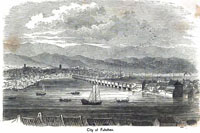 During Yuan Dynasty, Marco Polo the famous explorer named the city as Fugiu. This was not the local Min pronunciation but that of the Mandarin administrative class.
Between 1405 and 1433 AD (Ming Dynasty), a fleet of the Ming Imperial navy under Admiral Zheng He sailed from Fuzhou to the Indian Ocean seven times; on three occasions the fleet landed on the east coast of Africa. Before the last sailing, Zheng erected a stele dedicated to the goddess Tian-Fei (Matsu) near the seaport.
In the 19th century, Lin Zexu, born in Fuzhou, a high-ranking official of Qing Dynasty, led an attempt to resist British colonialism at Guangzhou. Unsuccessful and reviled by the East India Company, he was internally exiled to Xinjiang near the Russian border. By the 1842 peace treaty which concluded the Opium War I, Fuzhou became one of the five Chinese treaty ports, and it became completely open to Western merchants and missionaries. Since that time, Fuzhou flourish as major port and important hub of China to another countries.